
If you have been researching Theophilus Dunning in colonial Massachusetts, you have almost certainly hit a wall of contradictory records. He appears as a fisherman, then as a leather merchant. His wife is listed as Elin in some trees and Hannah in others. His arrival date seems to match a baptism record for someone else entirely. The reason for all of this confusion is simple: three entirely different men named Theophilus have been merged into one by over a century of genealogical errors. This page separates them permanently.
The Three Theophiluses
In the Massachusetts Bay Colony in the 1640s, three men named Theophilus appear in the records. They lived in different towns, belonged to different churches, held different occupations, and came from different countries. Here is who they actually were:
Theophilus Downing — Son of Emanuel and Lucy (Winthrop) Downing, baptized 13 January 1642 at the First Church of Salem. His mother Lucy was the sister of Governor John Winthrop. This child was born into one of the most prominent Puritan families in the colony.
Theophilus Downing “The Fisherman” — A separate man who received a land grant in Marblehead in 1642. He was married to a woman named Elin (Ellen). His son Benjamin Downing was baptized 17 November 1646. He is documented in Essex County court records in 1647 alongside his wife Elin.
Theophilus Dunning — Our subject. A Scottish Presbyterian from Edinburgh, born 1618. He arrived in Massachusetts around 1642. His son Benjamin Dunning was born 17 January 1647. His Y-DNA haplogroup is I-Y6851 — completely different from both Downing families above, and matching the Carruthers of Holmains, Scotland.
How the Errors Happened
Two specific mistakes created the confusion that has persisted for over a century.
The False Arrival Date — The Founders and Patriots of America Index records Theophilus Dunning as arriving in Massachusetts on 13 March 1642. This date is actually the baptism date of the infant Theophilus Downing, son of Emanuel and Lucy Winthrop Downing, recorded in the First Church of Salem. A transcription error transformed a Congregationalist baby’s baptism into an adult man’s arrival date, and swapped the surname Downing for Dunning in the process. These are not the same event, not the same person, and not the same family.
The Elin/Ellen Misattribution — Multiple published genealogies list Elin or Ellen as the wife of Theophilus Dunning. She was not. Elin was the wife of Theophilus Downing the fisherman of Marblehead. Essex County court records from 1647 make this explicit — a warrant was issued for the arrest of Elin, wife of Theophilus Downing, served by Henry Skerry, constable of Salem. The original record from The Essex Antiquarian is reproduced below.
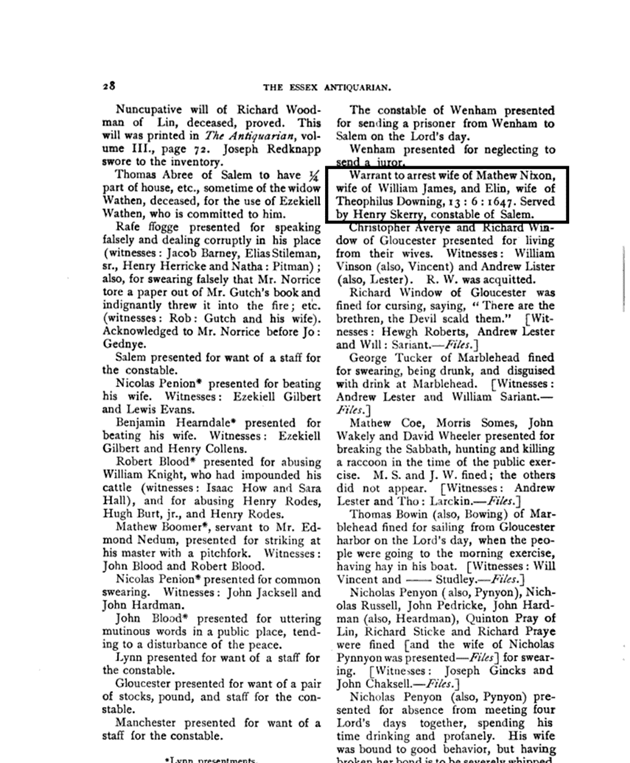
Frederick Virkus’s Abridged Compendium of American Genealogy further compounded the problem by labeling Theophilus Dunning as The Fisherman — a title belonging exclusively to the Marblehead Downing, documented in Marblehead town records and the Essex Registry of Deeds.
What the Salem Church Records Actually Show
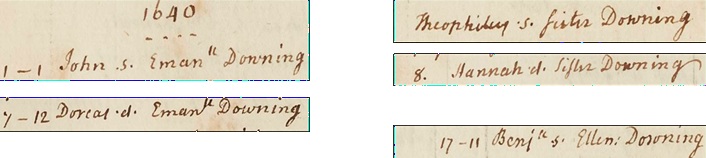
The original manuscript of the First Church of Salem records reveals a pattern that 19th century transcriptions completely obscured. When you read the original handwriting rather than the printed transcription, five baptism entries tell a very clear story:
John — baptized 1 January 1640 — listed under Eman” Downing (Emanuel)
Dorcas — baptized 7 December 1640 — listed under Eman” Downing (Emanuel)
Theophilus — baptized 13 January 1642 — listed under Sister Downing (Lucy Winthrop Downing)
Hannah — baptized 8 July 1644 — listed under Sister Downing (Lucy Winthrop Downing)
Benjamin — baptized 17 November 1646 — listed under Ellen Downing (Marblehead)
The shift from Eman” Downing to Sister Downing is the key. Emanuel Downing traveled to England in early 1642 and again in 1644 — exactly when those two baptisms were recorded under his wife’s church designation. Sister Downing is Lucy Winthrop Downing acting as presenting parent in her husband’s absence. The 19th century transcribed Vital Records reduced this designation to a blank dash, losing the attribution entirely and opening the door to over a century of misidentification. The original manuscript image is reproduced below.
Theophilus Dunning does not appear anywhere in these Salem church records — because he was Presbyterian, not Congregationalist. His absence from these books is not a mystery. It is exactly what we would expect from a Scottish Presbyterian immigrant worshipping outside the Congregationalist structure of the Bay Colony.
The Conclusion on the Confusion
Theophilus Dunning and Theophilus Downing were not the same man. They lived in different towns, belonged to different churches, held different occupations, and descended from completely different genetic lines. The Y-DNA evidence alone — R1b for the Downing families, I-Y6851 for the Dunning line — makes any biological connection impossible.
The next step is understanding where Theophilus Dunning actually came from. Continue to Scottish Origins.
 The Descendants and Origins of Theophilus Dunning