
Colonial Massachusetts: The Dunning Family in the New World
Theophilus Dunning arrived in Massachusetts around 1642 bringing with him a Scottish Presbyterian identity, a background in the textile and leather trades, and a surname that was not biologically his own. Over the next three generations, his descendants built a documented presence in colonial New England that confirms every aspect of the Scottish origin argued on this site.
Theophilus Dunning arrived in Massachusetts around 1642. He does not appear in the First Church of Salem records — entirely expected for a Scottish Presbyterian immigrant worshipping outside the Congregationalist structure of the Bay Colony. His presence in New England is confirmed through his son Benjamin, born in Salem on 17 January 1647.
Benjamin Dunning Sr.: Sealer of Leather, Boston 1682
Benjamin Dunning was born in Salem on 17 January 1647, the son of Theophilus. By 1682 he had established himself sufficiently in Boston to be elected to one of the most specialized municipal roles in the colony — Sealer of Leather.
The Sealer of Leather was not an honorary title. Under Massachusetts Bay Colony law, codified in 1646, it was illegal to buy or sell any tanned hide that had not been inspected and stamped with the Sealer’s official metal seal. The role required expert knowledge of tanning processes, leather grading, and quality standards. It was appointed by the town meeting and carried genuine civic authority. A man without a family background in the leather trade simply would not have been appointed.
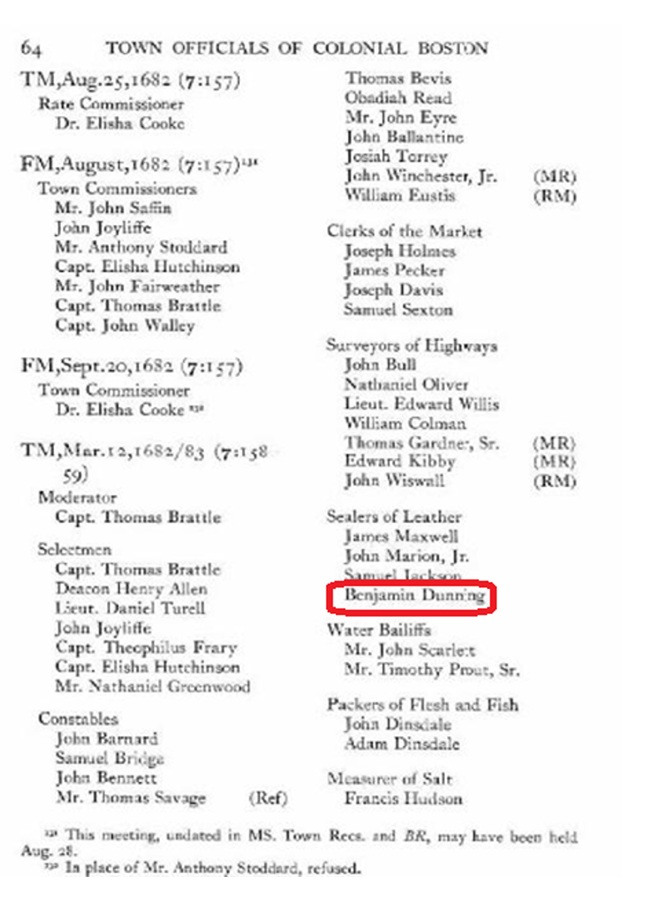
Benjamin Dunning is listed by name in the published Town Officials of Colonial Boston, page 64, under the Town Meeting of 12 March 1682/83. He appears alongside James Maxwell, John Marion Jr., and Samuel Jackson as one of four Sealers of Leather for the town. The original record is reproduced below.
From Boston to Jamaica, Long Island
After his years in Boston, Benjamin Sr. relocated to Jamaica, Long Island, where he appears in records in 1699 and 1708. From Jamaica his three sons spread out in different directions, carrying the Dunning line into Connecticut and New York.
The Three Sons
Benjamin Jr. (b. 1679) — moved to Fairfield, Connecticut. The Fairfield town records contain a remarkable entry confirming the family trade identity: “Benjamin Dunen hath this day land given him upon his dezire to come and live in this town… of making shoos… continue so long as ye town sees caus.” A man from a leather inspection family moving into shoemaking is occupational continuity across generations. Benjamin Jr. was baptized as an adult into Congregationalism at Stratfield Church on 30 May 1703 alongside his brother John. His Y-DNA independently confirms the Holmains Carruthers haplogroup I-FT191896.
John (b. 1681) — also settled in Fairfield, Connecticut. Baptized alongside Benjamin Jr. at Stratfield Church on 30 May 1703. His Y-DNA independently confirms the same Carruthers haplogroup.
Michael (b. 1685) — went to Orange County, New York, where he is recorded as a cordwainer in early 18th century occupation records. He was part of the founding group of Goshen, Orange County in 1719. Unlike his brothers he retained the family’s Presbyterian identity. His Y-DNA independently confirms the same Carruthers haplogroup — the third and final branch confirming the Scottish origin.
A Presbyterian Family in a Congregationalist World
One of the clearest markers distinguishing the Dunning family from the Downing families of Salem and Marblehead is religious identity. The Massachusetts Bay Colony was organized around Congregationalism — the dominant Puritan denomination. Being Presbyterian in that environment was a meaningful cultural statement, not a minor administrative detail.
Theophilus and Benjamin Sr. maintained their Presbyterian identity through two full generations in New England. This is exactly the pattern historians of Scottish immigrant communities would predict — first and second generation immigrants typically hold firmly to their homeland religious identity before the third generation begins to assimilate.
That assimilation is visible in the records. Benjamin Jr. and John conformed to Congregationalism at Stratfield Church in 1703 — the practical step of men establishing themselves in coastal Connecticut society. Michael, in New York, retained the Presbyterian faith. The geographic divergence maps directly onto the religious divergence. Connecticut’s more uniform Congregationalist environment drew Benjamin Jr. and John toward conformity. New York’s more varied religious landscape allowed Michael to maintain the family’s Scottish faith.
This pattern — two generations of Presbyterian identity followed by partial third generation assimilation — is not a contradiction of the Scottish origin argument. It is confirmation of it.
The DNA evidence that scientifically confirms everything documented on this page is presented in full on the next page. Continue to DNA Evidence.
 The Descendants and Origins of Theophilus Dunning