DNA Evidence: Scientific Confirmation of the Carruthers Connection
Documentary research establishes the lineage. DNA testing confirms it. This page presents the Y-DNA evidence that independently corroborates every conclusion reached through the primary historical records presented on the Scottish Origins and Colonial Massachusetts pages.
What is Y-DNA and Why Does it Matter?
Y-DNA testing traces the direct paternal line — father to son, father to son — across centuries with remarkable precision. Because the Y chromosome is passed virtually unchanged from father to son, men who share a common male-line ancestor will carry the same Y-DNA signature even centuries later. This makes Y-DNA uniquely powerful for genealogical research involving surname lines and family origins.
Y-DNA is organized into haplogroups — broad genetic families — and then into increasingly specific subclades identified by SNPs (Single Nucleotide Polymorphisms). The further down the SNP tree you go, the more specific and recent the shared ancestry becomes. When two men share a very specific subclade, they share a relatively recent common paternal ancestor.
The Critical Finding: Two Completely Different Haplogroups
Male-line descendants of the Salem Downing family — Emanuel and Lucy Winthrop Downing’s line — carry the R1b haplogroup. This is the most common haplogroup in England and Western Europe and is entirely consistent with English Puritan origins.
Male-line descendants of Benjamin Dunning Sr. (b. 1647) carry a completely different haplogroup: I-Y6851, a subclade of I1. These two haplogroups are in entirely separate branches of the human family tree with no recent common ancestry. The Dunning and Downing families are biologically unrelated through the male line. This is not a matter of interpretation — it is a genetic fact.
Three Independent Testers — Three Branches — One Result
Male Dunning (FTDNA Kit B265575) — descends through the Benjamin Dunning Jr. (b. 1679) branch
Male Dunning (FTDNA Kit 92294) — descends through the John Dunning (b. 1681) branch
Male Dunning (FTDNA Kit 123380) — descends through the Michael Dunning (b. 1685) branch
All three independently return the same result — haplogroup I-FT191896, the Holmains Carruthers specific branch. The probability of three independently descended male lines all returning the same result by coincidence is effectively zero. This is replication across independent branches — the gold standard of genetic genealogy evidence.
The SNP Path
The specific SNP path placing the Dunning testers on the Holmains Carruthers branch is:
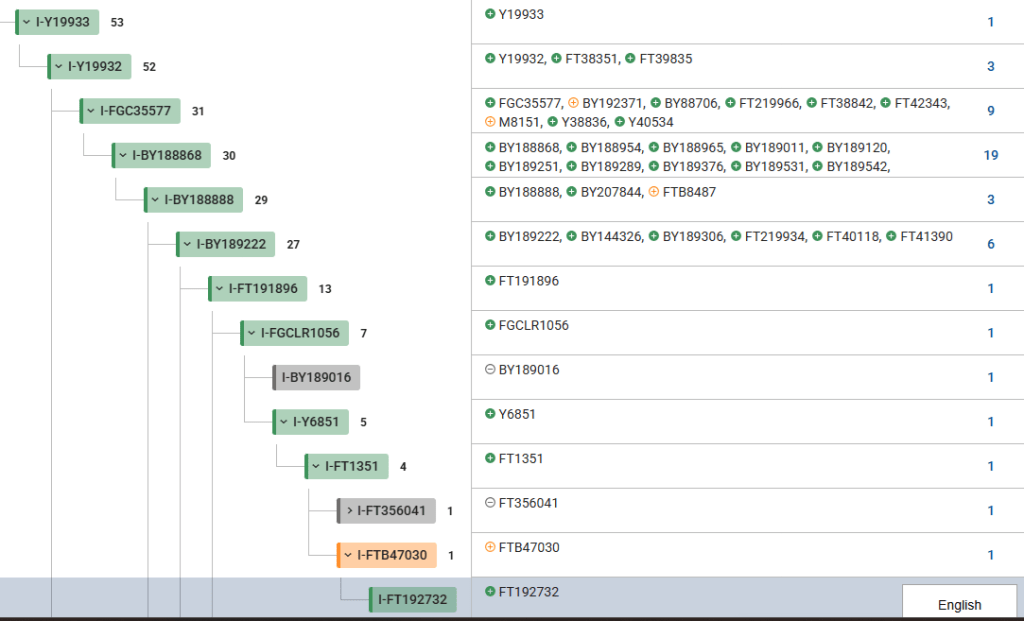
I-CTS11603 → I-FT191896 → I-BY189222 → I-Y6851
Above the I-FT191896 branch on the FamilyTreeDNA Block Tree, every tester carries a Carruthers, Carothers, or Crothers surname. The Dunning testers sit within this Carruthers-only group — the only non-Carruthers surname on the branch. The SNP Block Tree is reproduced below.
The Estimated Date Tree: Timing Confirms the Documentary Evidence
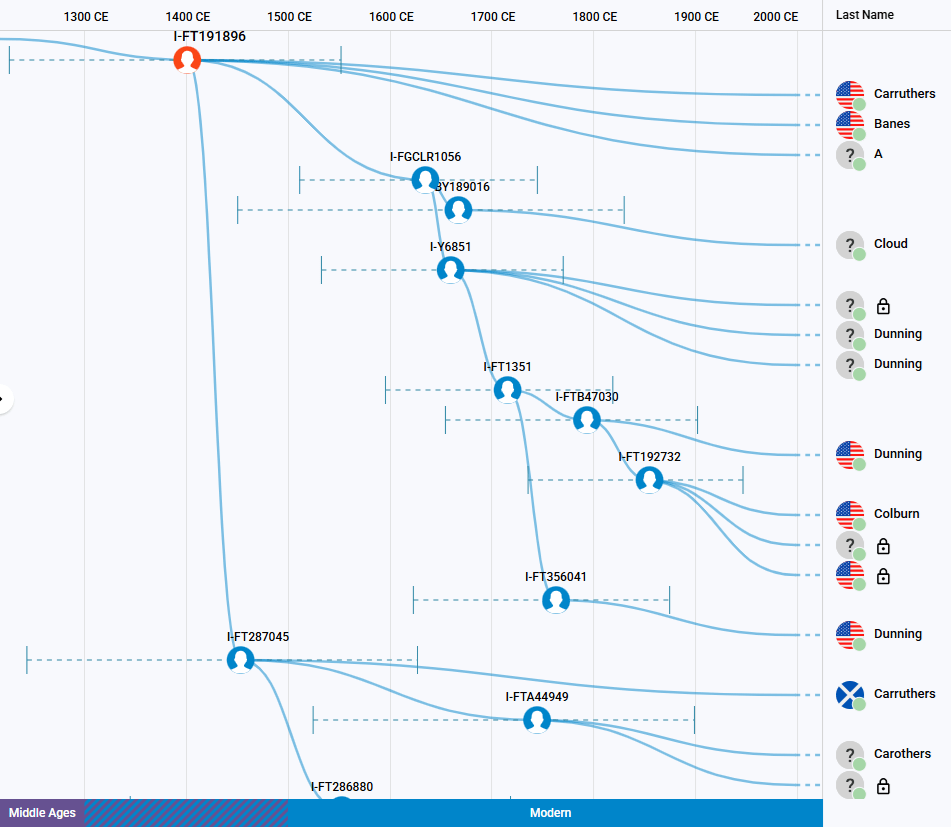
FamilyTreeDNA’s Estimated Date Tree provides a visual timeline showing when specific branches diverged. For this lineage the dates are remarkably consistent with the documentary evidence presented on the Scottish Origins page.
The I-FT191896 branch — the Holmains Carruthers root — is estimated to originate around 1400 CE. This is consistent with the documented Carruthers of Holmains whose records begin with John de Carruthers receiving the Charter of Half Raffles in 1361.
The Dunning-specific branches diverge from the Carruthers cluster in the 1500s to 1600s timeframe — exactly consistent with the Non-Paternal Event documented in Edinburgh in 1618. The timing of the genetic divergence matches the timing of the documentary event with precision that would be impossible to fabricate.
The Estimated Date Tree is reproduced below.
Confirmation from a Holmains Armiger
Gary John Carruthers FSAScot is a documented armiger of Clan Carruthers with a verified patrilineal descent from John Carruthers, 5th Laird and 1st Baron of Holmains, born circa 1494. He has reviewed the Y-DNA results of the three Dunning testers and provided the following formal statement:
I, Gary John Carruthers, FSAScot, am an armiger of Clan Carruthers with a documented paternal-line descent from John Carruthers, 5th Laird and 1st Baron of Holmains (born circa 1494). I have reviewed the Y-DNA results of these Dunning men, and I confirm that they and I share the same paternal Y-DNA lineage on the FamilyTreeDNA Block Tree, with both of us placed on the branch defined by haplogroup I-FT191896, which is specific to the Holmains Carruthers line. It is my opinion that the Dunning Y-DNA results are consistent with a male-line descent from John Carruthers, 5th Laird and 1st Baron of Holmains, notwithstanding the later surname change to Dunning. I have no objection to this statement being included in any documentation submitted to the Chief of Clan Carruthers or to the Court of the Lord Lyon.
What the DNA Confirms and What it Does Not
It is important to be precise about what the DNA evidence establishes and what it does not. The Y-DNA confirms that the paternal line of Theophilus Dunning’s descendants is biologically identical to the Holmains Carruthers line. It confirms this independently across three separate branches. It confirms that the Dunning and Downing families are completely unrelated through the male line. And it confirms that the branching point between the Dunning and Carruthers lines is consistent with a divergence event in the late 16th or early 17th century.
What the DNA cannot independently confirm is the identity of the specific individuals in the chain between the 6th Laird and Theophilus. That identification rests on the documentary evidence presented on the Scottish Origins page. The DNA does not contradict that evidence — it corroborates it precisely. The two types of evidence are doing different work, and together they make a case that neither could make alone.
The complete scholarly paper presenting all primary source documents, citations, and the full evidentiary assessment is available as a free download. Continue to Download the Full Research Document.
 The Descendants and Origins of Theophilus Dunning