Scottish Origins: The Carruthers Connection
Theophilus Dunning was born in Edinburgh, Scotland on 15 October 1618. His birth was not the beginning of the story — it was the culmination of a chain of events reaching back to the landed gentry of Dumfriesshire in the Scottish Borders, where the Carruthers family had held the estate of Holmains since the 14th century. This page presents the primary records that establish that chain.
The Carruthers of Holmains
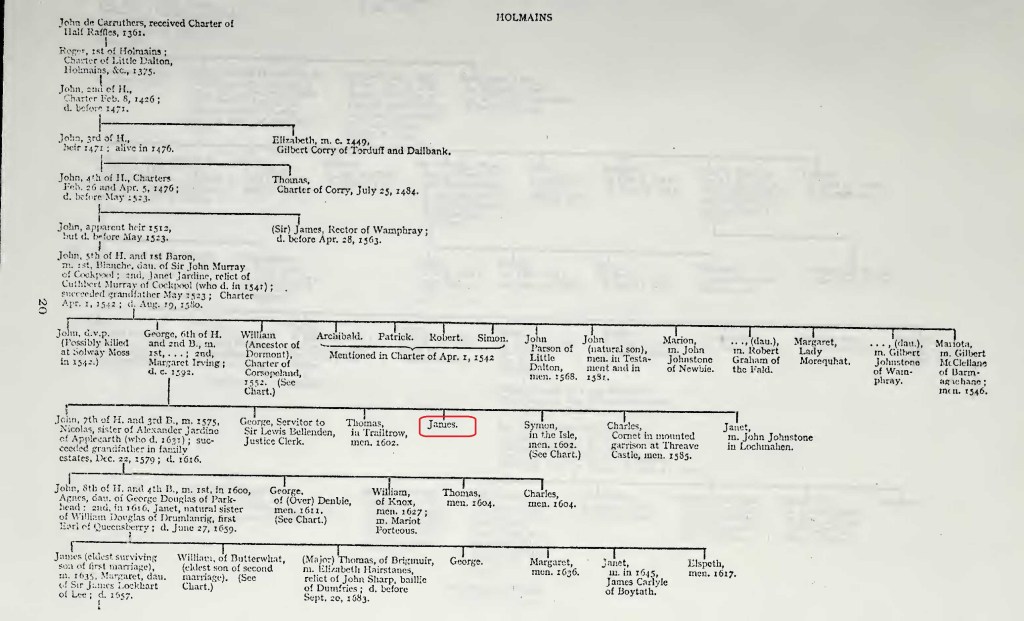
George Carruthers was the 6th Laird and 2nd Baron of Holmains. He is documented continuously in Dumfriesshire charters, sasines, and legal instruments from the Battle of Solway Moss in 1542 until his death before 22 May 1592. He had seven children. The eldest son John inherited the estate as 7th Laird. James — the ancestor in this lineage — received nothing under Scots primogeniture and followed the path typical of non-inheriting younger sons of landed families: he moved to Edinburgh and entered the urban trades.
The Holmains family chart from the Records of the Carruthers Family is reproduced below, showing James among the children of the 6th Laird.
The 1600 Edinburgh Apprenticeship Record
The Register of Edinburgh Apprentices for 15 April 1600 contains the following entry:
Carruderis, James, son natural to James C., with John Carruderis, tailor — 15 Apr. 1600
This single record carries substantial weight. Natural son in Scots legal usage means an illegitimate child — born outside formal marriage but acknowledged by the father. The apprenticeship places this James Carruthers within Edinburgh’s tailoring guild in 1600. A boy apprenticed at the typical age of 14 to 16 in 1600 would have been born around 1584 to 1586, making him 32 to 34 years old at the time of Theophilus’s birth in 1618 — well within normal fathering age. The original record is reproduced below.

Johnne Dunning, Burgess Tailor of Edinburgh
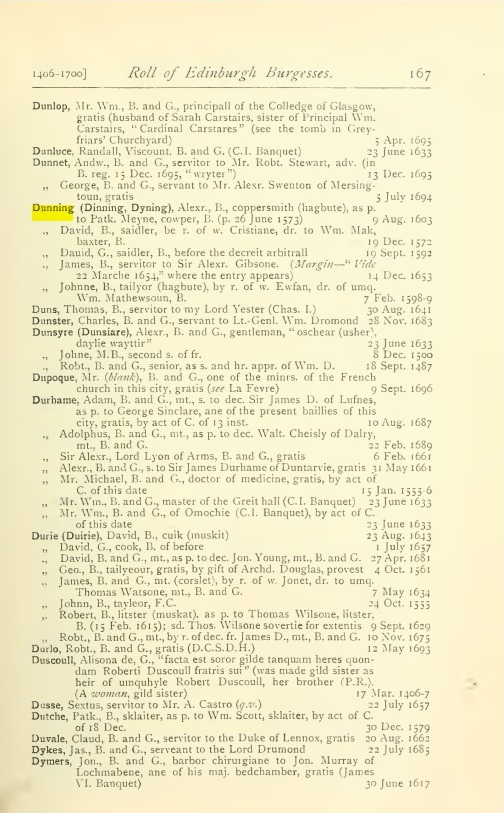
Johnne Dunning is documented in two independent Edinburgh records establishing him as a credible, established craftsman in the decade before Theophilus’s birth. His workshop operated within Edinburgh’s High Street craft districts — the same area where James Carruthers had been apprenticed in 1600.
First record — Register of Edinburgh Burgesses, 7 February 1598/9: Johnne Dunning, tailor (hagbute), by right of wife Ewfan Mathewsoun, dr. of umq. Wm. Mathewsoun, B. This confirms Dunning as a fully admitted burgess of Edinburgh, with militia service indicating solid civic standing.
Second record — Edinburgh Apprentice Register, 10 December 1606: John, son to John M., in Castlemadye, with John Dunning, tailor. This confirms his workshop was still active and taking apprentices eight years after his burgess admission — placing it directly contemporaneous with James Carruthers’s period of activity in the same city.
The Edinburgh Burgess Roll entry is reproduced below.
The 1618 Birth and Marriage Records: The Non-Paternal Event
The Edinburgh Old Parish Register for Parish 685/1 contains two entries dated 15 October 1618 that are the documentary heart of this entire case. On the same day, in the same parish, two things happened simultaneously: Johnne Dunning the tailor married Marion Bannatyne, and a child was born into that household.
The coincidence of date is the key. A child born on the same day as the marriage was conceived before the marriage took place. Johnne Dunning’s acknowledgment of the child on his wedding day, and the conferral of his surname, is what genealogists call a Non-Paternal Event — the biological father and the named father are different men. The biological father, based on occupational environment, generational position, and Y-DNA evidence, was James Carruthers.
The original manuscript marriage record is reproduced below.
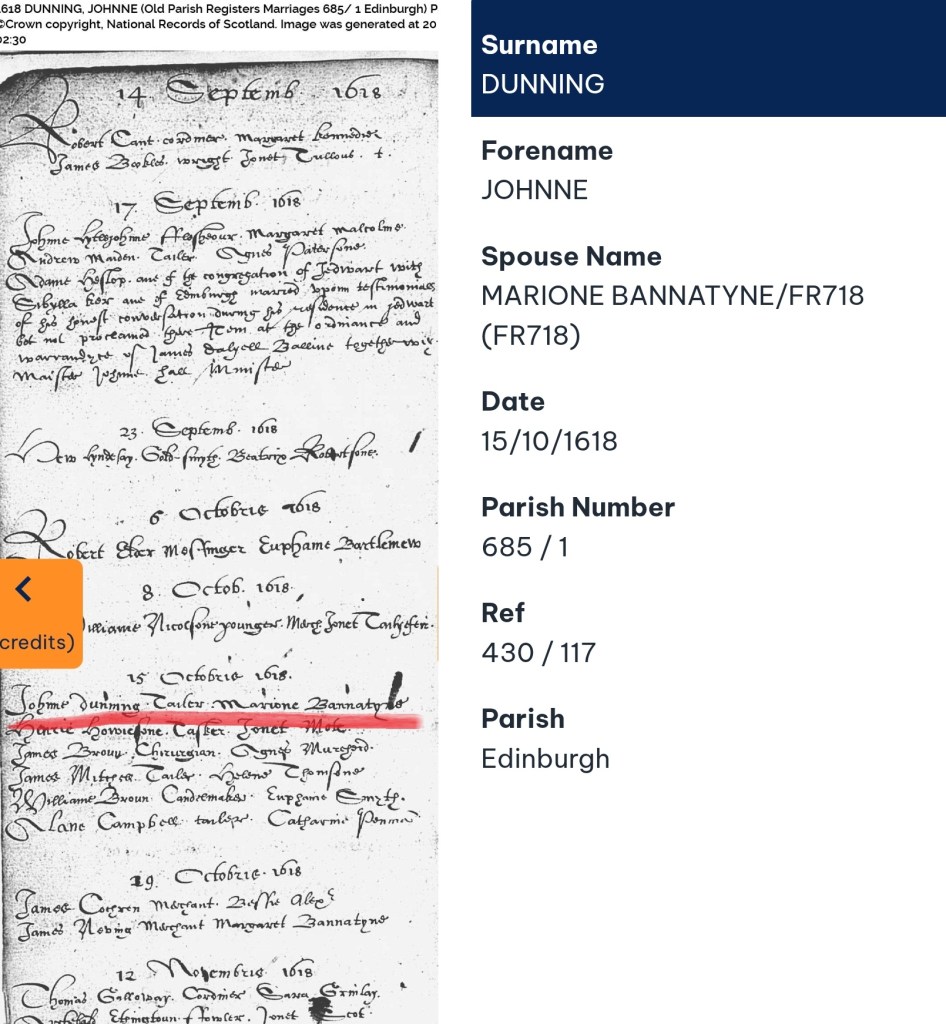
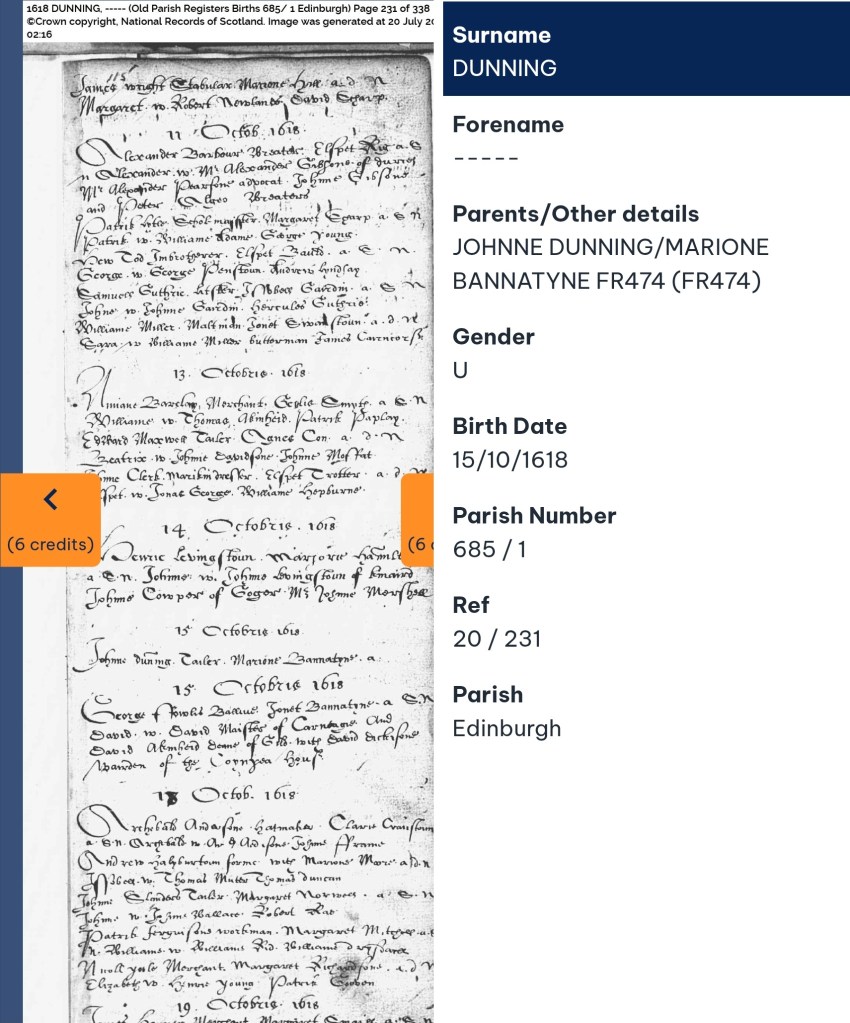
Both records carry the same date — 15 October 1618. A child born on the same day as its parents married was conceived before the marriage. This is the documented Non-Paternal Event at the heart of the Dunning-Carruthers lineage. Johnne Dunning acknowledged the child on his wedding day and gave it his surname. The biological father, based on Y-DNA evidence and occupational records, was James Carruthers.
What the DNA Confirms
Modern Y-DNA testing provides the scientific confirmation of everything the documentary records suggest. Male-line descendants of Theophilus Dunning carry haplogroup I-Y6851 — a subclade of I1 found specifically in the Carruthers of Holmains line. This is completely different from the R1b haplogroup carried by the English Downing families of Salem and Marblehead.
Three independent male-line testers — drawn from all three branches of Benjamin Dunning Sr.’s line — all return the same result. They share haplogroup I-FT191896 with Gary John Carruthers FSAScot, a documented armiger of Clan Carruthers with verified descent from John Carruthers, 5th Laird and 1st Baron of Holmains. The full DNA evidence is presented on the DNA Evidence page.
The Documented Chain
George Carruthers, 6th Laird of Holmains — Dumfriesshire, d. before 22 May 1592
James Carruthers — younger son of George, moved to Edinburgh
James Carruthers — natural son, apprentice tailor, Edinburgh, 15 April 1600
Theophilus Dunning — born Edinburgh 15 October 1618, surname from Johnne Dunning’s household
Benjamin Dunning Sr. — born Salem 17 January 1647, Sealer of Leather Boston 1682
Benjamin Jr., John, and Michael Dunning — three sons carrying the line into Connecticut and New York
The complete evidence with all primary source citations is available in the full research document. Continue to Colonial Massachusetts to follow the family’s story in the New World.
 The Descendants and Origins of Theophilus Dunning